





Filmmakers, Screenwriters, Performance, Reviews, Film Reviews, Streaming

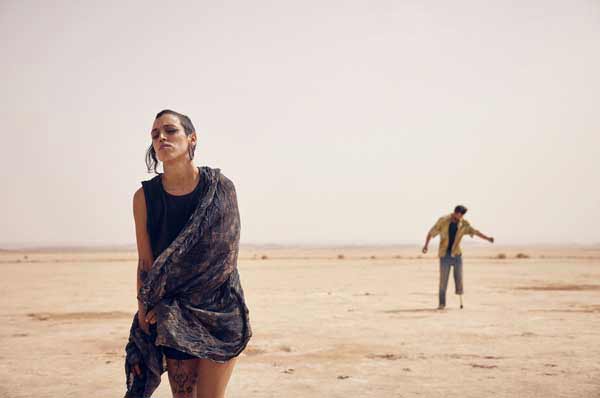
Photo Courtesy of NEON films
SIRĀT
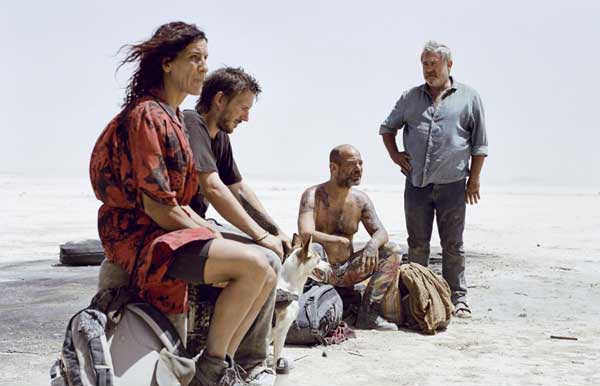
It starts with hands — scarred, tattooed, sunbaked — pushing heavy speakers into place. Electrical cables are plugged and twisted, fuses thrown, until a makeshift wall of subwoofers and tweeters rises into view, filling the horizon. A deep bass rumble — like a demon clearing its throat — swells into a throb you feel in your bones, followed by an abyssal pounding that recalls the ritualistic violence of Stravinsky’s “Rite of Spring.” Soon, a mass of gyrating bodies fills the screen — a hellscape reminiscent of Hieronymus Bosch — until the faces come into focus, revealing not torment but a loose-limbed ecstasy of elbows and fists. It feels as though we could stay here forever, dancing among this feral congregation of bassheads — but something unsettling presses in. A stranger appears, Luis (Sergi López), moving through the crowd with quiet urgency, handing out flyers bearing the photograph of his missing daughter — a fragile scrap of reality intruding on what moments before felt like pure abandon. Later, soldiers arrive to break up the rave, announcing that a major conflict — possibly World War III — has begun. Luis, his son Esteban, and five others splinter off in search of another gathering and Luis’ missing daughter. From this bare premise, director Oliver Laxe spins out a search narrative that gradually mutates into something more elemental — less a story than a passage — one where survival depends not just on endurance, but on faith and the uneasy acceptance of forces beyond human control.
The look of the film is burnished, with cinematographer Mauro Herce bathing the first half in amber warmth before shifting to a harsher, pitiless light — like an interrogation — in the second. At night, his compositions reduce the travelers to near insignificance, their truck headlights carving a fragile path across the vast desert floor while distant mountains glow beneath cold blue moonlight. The music — a mixture of techno, experimental, and ambient sounds by Kangding Ray — provides a sensorial bedrock that acts as a kind of guide, never commenting on the action or dictating emotion, but instead offering a point of view, like the sky glimpsed between rock formations, or the steady horizon seen from a moving vehicle. The cast is made up largely of non-professionals pulled from the dance floor during Laxe’s years embedded in European raver communities, their unstudied honesty recalling Robert Bresson’s preference for instinct over technique. Their hardened faces carry a mixture of grief and resilience, like migrants captured in Dorothea Lange’s photographs. But there is a wild buoyancy and radiant happiness bubbling up from within these characters — a resilience that belies their place on society’s margins and hints at emotional reserves beyond the reach of most people. Even when the journey darkens to an unimaginable degree, they never lose their hard-earned resourcefulness in a world they’ve long since learned to navigate in all its grim unpredictability. In Islamic eschatology, the Sirāt is the narrow bridge suspended over Hell — a perilous crossing every soul must attempt on the Day of Judgment to reach Paradise. Laxe embraces this idea in the most visceral way possible, a decision that has sparked controversy over the film’s direction and the seemingly arbitrary cruelty visited upon characters we’ve come to care about. And that reaction is understandable. Taken at face value — without the larger spiritual framework Laxe painstakingly builds, though not everyone sees it — “Sirāt” can verge on the unbearable. One friend confessed that it made her “want to take a swan dive off her deck.” My experience was decidedly different. Yes, the film offers an unblinking examination of loss — which I won’t go into here to avoid spoilers — and yet, on the other side of that suffering, the possibility of rebirth glows like a promise. I found myself not saddened by the ending but strangely energized. It called to mind the Franciscan Peace Prayer — “It is by dying that one awakens to Eternal Life” — and the Stoic practice of memento mori, the quiet reminder that death is not abstract but inevitable. Laxe is confronting the suddenness of loss, insisting that the audience feel its force without mediation or escape. In a conversation with a reporter from “Interview,” he described cinema as a place for catharsis — a space where we can “connect with this wound that all of us have.” What emerges from that confrontation is not despair, but a hard-earned clarity — the sense that life, precisely because it can vanish without warning, must be lived with greater attention and care, like a rhythm felt deep in the body long after the music has stopped.
Available on HULU. |
|
An LA-based playwright, JUSTIN TANNER has more than twenty produced plays to his credit, including Voice Lessons, Day Drinkers, Space Therapy, Wife Swappers, and Pot Mom, which received the PEN-West Award for Best Play. He has written for the TV shows Gilmore Girls, My So-Called Life and the short-lived Love Monkey. He wrote, directed and edited 88 episodes of the web series Ave 43, available on YouTube. Tanner is the current Playwright in Residence for the Rogue Machine Theatre in Hollywood, where his most recent play My Son the Playwright, of January of 2026, was met with rave reviews. Travis Michael Holder of the LA Drama Critics Circle wrote, "a phenomenal new achievement by local counter-culture hero Justin Tanner.”
|


To receive a free subscription to our Sunday Lounge! newsletter, Click Here
Have a suggestion? Send an email to the Editor, Click Here