





Filmmakers, Screenwriters, Performance, Reviews, Film Reviews, Streaming

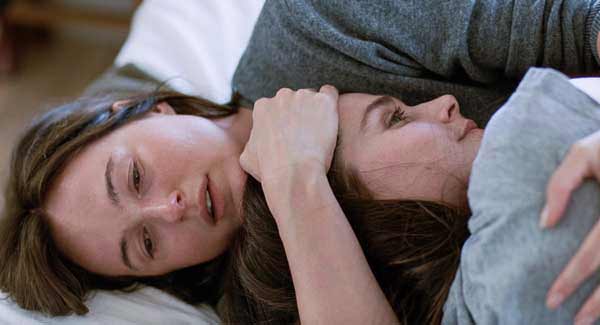
Photo Courtesy of NEON films
SENTIMENTAL VALUE
Early in Joachim Trier’s Oscar-winning film "Sentimental Value," Nora, a hyperventilating actress played with baffling singularity of tone by Renate Reinsve, is revealed in her dressing room in the middle of a panic attack. The stage manager knocks, calling “Places!” Nora won’t budge, and nobody can make her. So determined is she not to go on that she starts to rip off her costume, tearing a large hole down the back in the process — damage hastily sealed with duct tape seconds before she finally forces herself into the spotlight. It’s only then that we understand what the real problem is — and stage fright is the least of it. Whatever unnamed play Nora’s been avoiding, boy is it a doozy! So ostentatiously pretentious that at first I took it for parody. Like that early SNL sketch “Bad Playhouse,” which featured scenes from the worst plays ever written, I half expected Dan Aykroyd to pop in and say, “There now, that wasn’t so good, was it?” before tossing the script into a trash can. How else are we to take the moment where Nora stares at the audience in silent rage, strobe lights flashing and bass-and-drum music blasting, before intoning the epically quotable: “You said you were going to save me! Yet you chased me into the flames!” with a totally straight face? But Trier isn’t kidding. Nora’s play is meant to register as deeply important and serious. And the disconnect between its sheer awfulness and how it’s being received — the curtain-call ovation is positively rapturous — becomes an uncrossable chasm that prompts the question: “What other tonal misfires does Trier have up his sleeve?” The answer is: plenty. Though the film opens with a thoroughly charming voice-over montage about the Borg family home, told from the house’s point of view, nothing that follows comes close to fulfilling the promise of those first three minutes. Yes, Trier is dealing with death, depression, generational trauma — he even throws in Nazis for good measure — so a certain gravity is understandable. But after two and a quarter hours of unrelenting despondency delivered at the same ceremonious pace — like a metronome set to 20 BPM — the film starts to collapse under its own factitious profundity. Which is too bad, since the story itself is dense with incident: a struggling filmmaker father (Stellan Skarsgård), a family haunted by suicide, a movie star (Elle Fanning) slumming it for Netflix, Nazis, an illicit affair, and a daughter who turns down a juicy role in her dad’s movie just to piss him off. On paper, it’s volatile material. Onscreen, it just lays there. Only in the final act does something happen to cut through the prevailing torpor, as Nora’s sister Agnes (a radiant Inga Ibsdotter Lilleaas) confronts her absentee father in a burst of genuine rage. After so much hushed restraint, the shock of someone finally speaking plainly feels like a window thrown open. But it arrives too late to restore the momentum that has already slipped away. The suicide subplot is also troubling, particularly in the way Trier centers it within the film-within-the-film, framing the act of hanging with an obsessive reverence that feels uncomfortably close to ritual. His decision to end “Sentimental Value” with yet another sequence of suicidal ideation is just another example of Trier misreading the room. What’s presented as a warm-hearted reconnect between father and daughter strikes a discordant note instead, leaving us — me, anyway — with the unsettling, albeit unseen, image of a dangling rope. Perhaps that’s Trier’s intention, but if he’s getting at a larger point, I haven’t a clue what it is. Woody Allen’s “Interiors,” another tale of familial despair, handled similar material with greater clarity — leavening its severity with flashes of color and moments of mordant humor that kept its gloom from hardening into tedium. But “Sentimental Value” simply refuses to lighten up, and Reinsve spends most of the film riding a monumental bummer. Even the great Stellan Skarsgård feels curiously diminished, never fully convincing us of the egomaniacal director he’s meant to embody. Still, there are scenes throughout the film that, taken on their own, gleam with clarity and truth: the sisters sparring passive-aggressively over their dead mother’s vase; Nora being turned down by her married lover; Hollywood actress Rachel Kemp admitting she isn’t good enough to play a part in Skarsgård’s film. They work well as individual moments that, when strung together, never quite form a coherent emotional whole. Much like the ridiculous stage production that opens the film, “Sentimental Value” is mounted with absolute conviction but little sense of proportion. The emotions are sincere, the intentions honorable — yet the relentless solemnity leaves no room for discovery or release. For all its careful staging, the promised catharsis never arrives, leaving us instead with the dull ache of expectation unmet.
|
|
An LA-based playwright, JUSTIN TANNER has more than twenty produced plays to his credit, including Voice Lessons, Day Drinkers, Space Therapy, Wife Swappers, and Pot Mom, which received the PEN-West Award for Best Play. He has written for the TV shows Gilmore Girls, My So-Called Life and the short-lived Love Monkey. He wrote, directed and edited 88 episodes of the web series Ave 43, available on YouTube. Tanner is the current Playwright in Residence for the Rogue Machine Theatre in Hollywood, where his most recent play My Son the Playwright, of January of 2026, was met with rave reviews. Travis Michael Holder of the LA Drama Critics Circle wrote, "a phenomenal new achievement by local counter-culture hero Justin Tanner.”
|


To receive a free subscription to our Sunday Lounge! newsletter, Click Here
Have a suggestion? Send an email to the Editor, Click Here