





Filmmakers, Screenwriters, Performance, Reviews, Film Reviews, Streaming

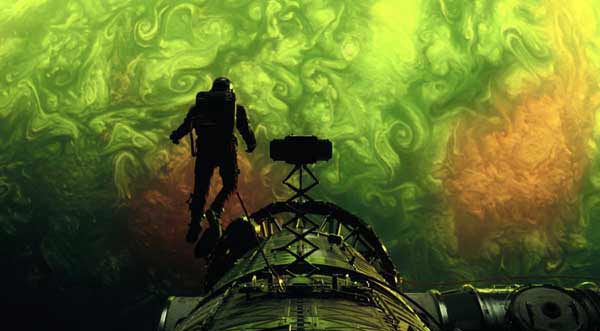
Photo Courtesy of Amazon-MGM-Studios
PROJECT HAIL MARY
Hollywood has carried on a long love affair with the cinematic man-child, a character so profitable that the industry now treats him less as an archetype than as a commercial strategy — reshaping him for each new generation without asking whether he still makes sense. Jerry Lewis defined the template as barely contained havoc. Tom Hanks softened it into something gentler, almost saintly. Later performers like Adam Sandler and Will Ferrell pushed it toward spectacle, noise, and manic comic rage. In "Project Hail Mary," Ryan Gosling inherits the mantle — only by now the formula has begun to fray at the edges. In the film, Gosling plays Ryland Grace, a middle-school science teacher — and former molecular biologist — who wakes alone aboard a spaceship with no memory of how he got there. Through a slog of ponderous flashbacks, we learn that Earth faces extinction and that Grace is headed toward a distant star that may hold the answer. Gosling has had an exceptional career, building a gallery of gentle misfits, complex dreamers, and accessible pranksters — characters defined by an innate emotional intelligence. Here, however, he feels miscast. Good as he is — reliably warm and engaging — he’s simply too handsome and magnetic to be believable as a neutered, feckless science nerd, someone who seems never to have been on a date or encountered a problem he didn’t feel compelled to solve. Consequently, we can’t quite get a bead on who he is. It doesn’t help that he spends the first third of the film bumping into walls and flailing around like a ten-year-old. When we finally learn that Grace was once a molecular biologist, it hardly reconciles with the doofus in a spacesuit we’ve been watching. Part of the problem stems from the plot contrivance of Grace’s “retrograde amnesia,” blamed on four years in a medically induced coma but functioning less as character development than as a storytelling loophole — an all-purpose device that allows Gosling to fumble through slapstick when laughs are needed and snap into implausible brilliance whenever the plot demands it. Worse, it keeps Gosling from shaping Grace into a recognizable human being. He spends three quarters of the film unable to fully remember his past, leaving him without a fixed starting point and us without any sense that he’s moving toward meaningful change. Without a clear origin, there can be no transformation — and without transformation, there is no drama. Grace remains inert and unknowable, relying almost entirely on Gosling’s inherent charm to fill in the blanks. The movie’s inconsistent tone exacerbates the problem, lurching from broad three-camera sitcom hijinks to maudlin sentimentality and back again, all accompanied by an insistent, wall to wall score that never stops telling us how to feel. But the central problem — and it’s a major one — is structural.
The decision to mimic the novel’s back-and-forth timeline, drawn from the storytelling style of Andy Weir — best known for "The Martian" — turns out to be a fundamental miscalculation. In prose, leaps in time can heighten tension by withholding information and allowing parallel storylines to converge. On screen, however, those same shifts fracture momentum, interrupting the story just as it begins to gather force. What reads as suspense on the page often feels like stalling in a film. Late in the third act, we discover that Grace did not board the spaceship voluntarily — that he had to be drugged and forced into saving humanity against his will. In the novel, this revelation carries emotional weight because we remain inside Grace’s mind as he struggles to recover his memory, experiencing his fear, hesitation, and shame alongside him. In the film, however, we are denied that interior perspective. Without access to his inner conflict, the late reveal that Grace initially refused the mission feels less like a turning point than a narrative afterthought. Had this moment appeared at the beginning, it might have provided the foundation for a meaningful arc — fear giving way to reluctant courage. Instead, it explains nothing and redeems little. At two and a half hours, "Project Hail Mary" is easily an hour too long — a B-movie with delusions of grandeur, a romp bloated into a would-be epic that outstays its welcome and then some. Jettisoning the endless explanations about Grace’s mission — mysterious organisms called astrophages draining energy from the sun — would save at least forty-five minutes of screen time. In older science-fiction films, this kind of analytical hogwash would be dispatched in a single three-minute briefing. Here, it’s stretched beyond reason into a parade of incomprehensible flashbacks whose only real purpose seems to be inflating the film with a fraudulent sense of importance. Worse still, none of this elaborate groundwork deepens the drama — it merely delays it. Yet, there is much to admire in "Project Hail Mary." Gosling, of course, is terrific — even in a role better suited to someone like Jason Segel or Seth Rogen, he remains reliably engaging. The special effects are thrilling, the action sequences inventive and tense, and the film ultimately lands on a satisfying conclusion that — had it arrived an hour earlier — might have earned an honest cheer. Best of all is Rocky, the oddly endearing five-legged alien scientist Grace encounters along the way. Through beautifully staged scenes, the two learn to communicate and care for one another, forming the film’s most authentic emotional connection. Directors Phil Lord and Christopher Miller ("The Lego Movie") wisely bypass the usual CGI-heavy approach, hiring designer James Ortiz and his team to bring Rocky to life through Bunraku-style puppetry and animatronics. The result is a creature who feels tactile, believable, and fully alive. It’s too bad this central relationship can’t rescue "Project Hail Mary" from the base-level inconsistencies that keep its world from holding together. No matter how much money is spent constructing a credible universe, one lame dad joke or stray meta reference can snap the audience’s suspension of disbelief in an instant. Drew Goddard’s grab-bag script throws ideas at the wall with little regard for whether they align with the rules the film itself has established, creating a world so elastic that consequence begins to feel optional. Are we really meant to believe, with no rational justification, that out of the tens of thousands of molecular biologists in the world, only this jittery middle-school teacher can save humanity? That he can pilot a spacecraft — something that should take years to master — with no training, using what appears to be little more than a video-game joystick? At a certain point, the accumulation of such shortcuts doesn’t create excitement — it erodes trust. Or at least it should. At the screening I attended, there were plenty of laughs and tears despite the film’s increasingly casual disregard for its own internal logic. But big-budget films these days often seem designed to discourage independent thought. Image and sound, dialogue and music, editing and camera movement — all work overtime to bypass analytical reasoning and induce a state of pure sensation, ensuring we feel precisely what they want us to feel at any given moment. They seem to have forgotten Ernst Lubitsch’s famous advice: “Let the audience add up two plus two. They'll love you forever.” Instead, filmmakers spoon-feed answers before we’ve even had the chance to form a single question. Hollywood has lost the plot, confusing sensation with storytelling and noise with meaning. They’ve forgotten how to trust the stories they tell, abandoning logic for spectacle and hoping we won’t look too closely at the seams. Judging by "Project Hail Mary"’s box office — $443,000,000 to date — their plan appears to be working. And as long as audiences keep buying tickets, there’s little incentive for them to learn the difference. |

|
An LA-based playwright, JUSTIN TANNER has more than twenty produced plays to his credit, including Voice Lessons, Day Drinkers, Space Therapy, Wife Swappers, and Pot Mom, which received the PEN-West Award for Best Play. He has written for the TV shows Gilmore Girls, My So-Called Life and the short-lived Love Monkey. He wrote, directed and edited 88 episodes of the web series Ave 43, available on YouTube. Tanner is the current Playwright in Residence for the Rogue Machine Theatre in Hollywood, where his most recent play My Son the Playwright, of January of 2026, was met with rave reviews. Travis Michael Holder of the LA Drama Critics Circle wrote, "a phenomenal new achievement by local counter-culture hero Justin Tanner.”
|


To receive a free subscription to our Sunday Lounge! newsletter, Click Here
Have a suggestion? Send an email to the Editor, Click Here